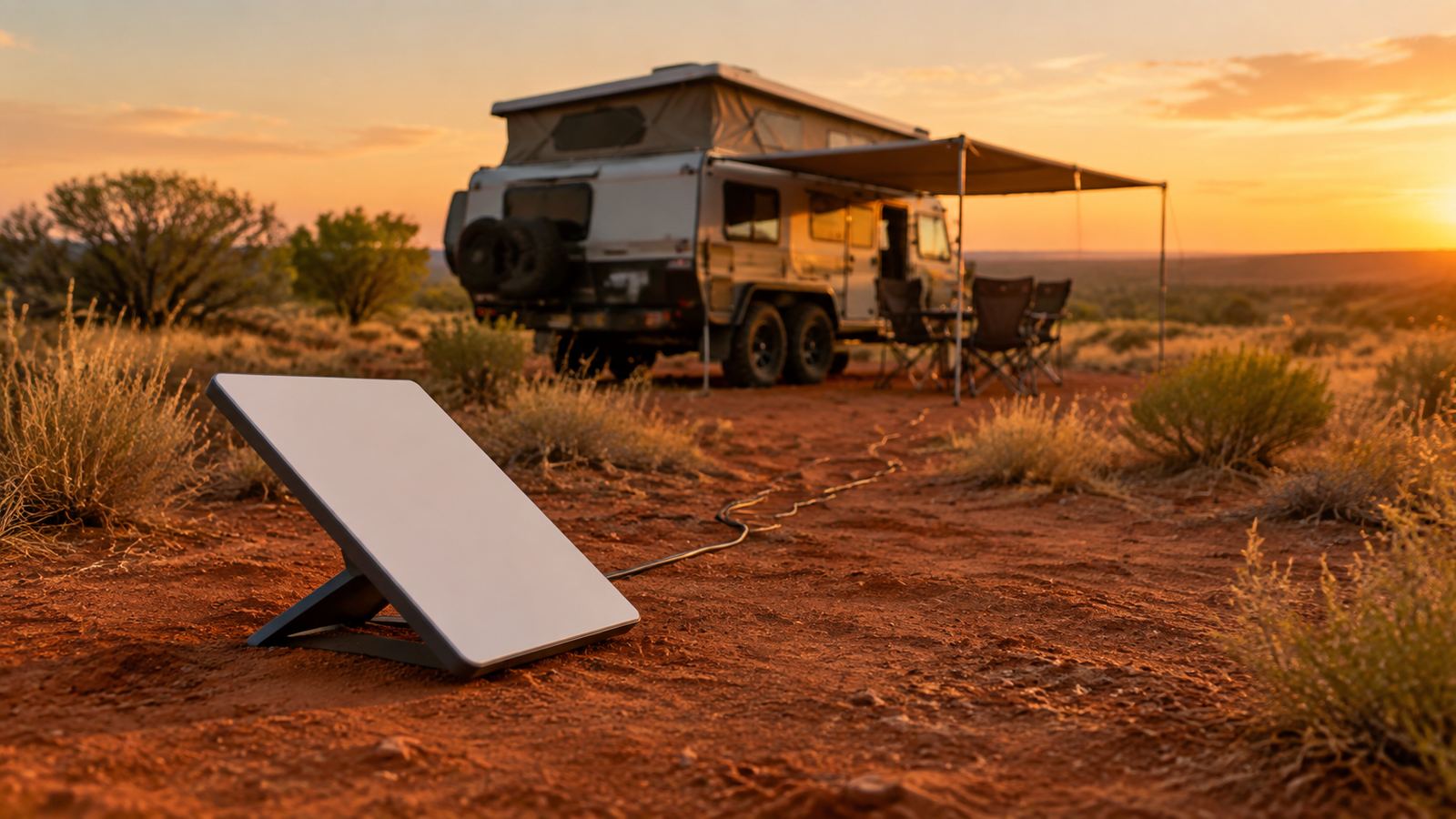
For a caravan, buy a Starlink Mini and put it on a Roam plan. The Mini takes 12 to 48 V DC directly, so it runs off your battery with no inverter, and it draws 25 to 40 W against the Standard dish’s 75 to 100 W.
That is the short answer, and most guides get there too. Where they go wrong is the numbers attached to it.
The prices in most caravan guides are too high
Google’s AI Overview for this question, checked on 10 September 2026, puts Mini hardware at “around $399” and Roam plans at “$85 to $174+ per month”.
Checked against the sellers and Starlink’s own Australian site the same day:
| Commonly quoted | Actual | |
|---|---|---|
| Starlink Mini kit | around $399 | $287 at Bunnings and Officeworks, $289 at JB Hi-Fi |
| Roam 100GB | $85 | $85, correct |
| Roam Unlimited | ”$174+“ | $210 |
The $174 is not an Australian price at all. Starlink’s American pricing page ranks on Australian searches, and US Roam Unlimited sits at US$175, which is where that number comes from. We went through the same problem in detail on our Starlink cost page.
So the real hardware figure is about $110 lower than most caravan guides say, and the real unlimited plan is about $36 a month higher. Both matter when you are working out whether to bother.
Why the Mini, specifically
The Mini wins on the 3 things that decide it in a van, and Starlink publishes all of them.
Power. The Mini draws 25 to 40 W and accepts 12 to 48 V DC directly. The Standard 4 X draws 75 to 100 W and runs off an AC supply, so in a van it needs an inverter, which adds losses and another thing to fail. At 30 W average the Mini pulls roughly 2.5 A at 12 V, so about 60 Ah across a full day of use. The Standard at 90 W is closer to 180 Ah.
Size and weight. The Mini is 298.5 by 259 by 38.5 mm and weighs 1.53 kg with its kickstand and 15 m cable. The Standard 4 X is 594 by 383 mm and 3.8 kg rigged the same way. 1 lives in a drawer, the other needs a plan.
The router is inside it. The Mini has integrated Wi-Fi, so there is no separate router box to find a home for. In a van that is a genuine advantage. In a house it is the Mini’s main weakness, because the dish has to be outside and so does its Wi-Fi. We compared the 2 units properly in Starlink Mini vs Standard.
What you give up is a lower speed ceiling and 112 m² of Wi-Fi coverage against the Standard’s 297 m². Neither matters in a caravan.
Which Roam plan, and the Standby trick
Roam comes in 2 tiers, and as at 10 September 2026 the gap between them is $125 a month.
Roam 100GB at $85 gives you 100GB at full speed, then unlimited data at a reduced speed. It does not cut you off. For maps, messages, email and the occasional film that is plenty.
Roam Unlimited at $210 removes the throttle. If you stream most evenings or work from the van, this is the one.
Here is the part that changes the maths for most caravanners: Roam bills in one-month blocks and has a Standby mode, which drops you to a small monthly fee, keeps emergency messaging alive, and lets you switch the service back on from a dead zone.
If you travel 8 weeks a year, that is 2 months of Roam plus 10 months of Standby, not 12 months of Roam. Anyone quoting you an annual Starlink cost for a caravan on the assumption of 12 full months is describing a full-timer, not you.
What it actually costs to run
On the 10 September 2026 prices above, buying a Mini at $287 and travelling 8 weeks a year, on Roam 100GB:
| First year | Following years | |
|---|---|---|
| Mini kit | $287 | nil |
| 2 months of Roam 100GB at $85 | $170 | $170 |
| 10 months of Standby | small monthly fee | small monthly fee |
| Rough total | about $457 plus Standby | about $170 plus Standby |
Compare that to a full-timer on Roam Unlimited: the same $287 Mini plus 12 months at $210 is $2,807 in year one.
Same hardware, same network, and a difference of well over $2,000 depending entirely on how much you actually travel. That is the number to work out before you buy anything.
We have not published a figure for the Standby fee because we have not verified Starlink’s current Australian one, and a guessed number in that table would be worse than a gap.
Power and mounting, the parts that go wrong
Run it off 12V directly. The Mini’s input rating is 12 to 48 V at 60 W. Wiring it into the van’s system through a proper DC lead avoids the inverter entirely. Running a Mini through an inverter to reach a 240 V brick, then back down, is a common setup and it wastes power for no reason.
Do not roof-mount it permanently without thinking hard first. This is the one where experienced travellers and the manufacturer quietly agree. The dish needs an unobstructed view of a 110 degree cone of sky. Permanently fixed to a roof, the dish points where the van points, and you cannot move it when you park under the only shade tree in the campground. A portable setup on the ground or a pole lets you walk it 4 metres and fix the problem.
Both the Mini and the Standard 4 X ship with a built-in kickstand that flips out and folds away, and the Mini Kit also includes a Pipe Adapter and Flat Mount that fits any pole between 31 mm and 50 mm, so a jockey-wheel or pole setup needs no extra parts.
Check the sky before you settle in. The Starlink app has an obstruction tool that scans the sky with your phone camera and shows you exactly where the signal is blocked. It takes about 2 minutes and it is the difference between a working evening and blaming the weather.
What we see across our own hire fleet
We hire Starlink Mini kits to travellers across Western Australia, which means these are working caravan and 4WD deployments rather than a test bench.
Esperance, summer 2025-26: 180 Mbps down. 4K streaming of an evening, voice calls during the day.
Exmouth, July 2026: 175 Mbps down. Same pattern, and the hirer reported no drop-outs across the trip.
Across the fleet the range is 100 to 200 Mbps down, 10 to 20 Mbps up, and 20 to 40 ms latency, and setup is typically under 5 minutes on the kickstand. Those are 2 dated readings and a working range, not a large sample, and I would rather give you that than a confident average I cannot show you.
For context, the ACCC measured Starlink at 230.4 Mbps across all hours on Residential Max, its top home plan on roof-mounted hardware. Our Mini kits on a mobile plan, sitting on the ground at campsites, land within about 25% of that. The detail is on our Starlink speeds page.
Should you hire one first?
Past roughly 6 weeks of total use, buying a Starlink Mini wins outright. Under that, hiring is usually cheaper. We hire kits, so weigh this accordingly and then check the arithmetic.
If you are going once, or you are not sure satellite suits how you actually travel, hiring answers the question for a fortnight’s rent instead of a purchase. Our Starlink hire out of Perth runs one plan, unlimited, at $179 a week for 7 to 13 days, $22 a day from 14 days and $19 a day from 25 days, with a $300 refundable bond. Pickup is from Cloverdale, 5 minutes from Perth airport.
2 honest limits on that. It is Western Australia only, with Uluru and Darwin the only interstate exceptions, and there is no shipping in either direction, so it is pickup from the depot. And past roughly 6 weeks of total use, buying wins outright, which we set out in hire cost versus buying.
Questions caravanners actually ask
How much does Starlink cost for a caravan? As at 10 September 2026, a Starlink Mini kit is $287 and Roam is $85 or $210 a month, plus Standby between trips if you are not travelling year-round. Prices in this market move, so check yours before ordering.
What is the best Starlink for caravans? The Starlink Mini. It takes 12V directly, draws 25 to 40 W, weighs 1.53 kg rigged, and has its Wi-Fi built in.
Can I use Starlink in my caravan while driving? Not on a standard Roam plan with the kickstand setup. In-motion use needs the right plan and a proper fixed mount, and the kickstand is not one.
Is the Starlink Mini suitable for caravans? It is the unit Starlink designed for exactly this, and it is the only one of the 2 that runs off 12V without an inverter.
Do I need to pause my plan when I get home? You do not have to, but Standby mode is why Roam suits seasonal travellers. Paying 12 months for 8 weeks of use is the most common mistake here.
Will it work under trees? No. The dish needs a clear view of a 110 degree cone of sky, and a single overhanging branch will cut throughput. Use the app’s obstruction tool before you set up.
Does rain stop it? Rarely, and weather is overstated in most caravan guides. Obstructions cause far more trouble than storms.
Before you buy
Put your address into Starlink’s site to see the current hardware price and any promotion, because it moves and it varies by location. If this is one trip rather than a way of life, hire a kit first and find out what you actually need before spending anything.