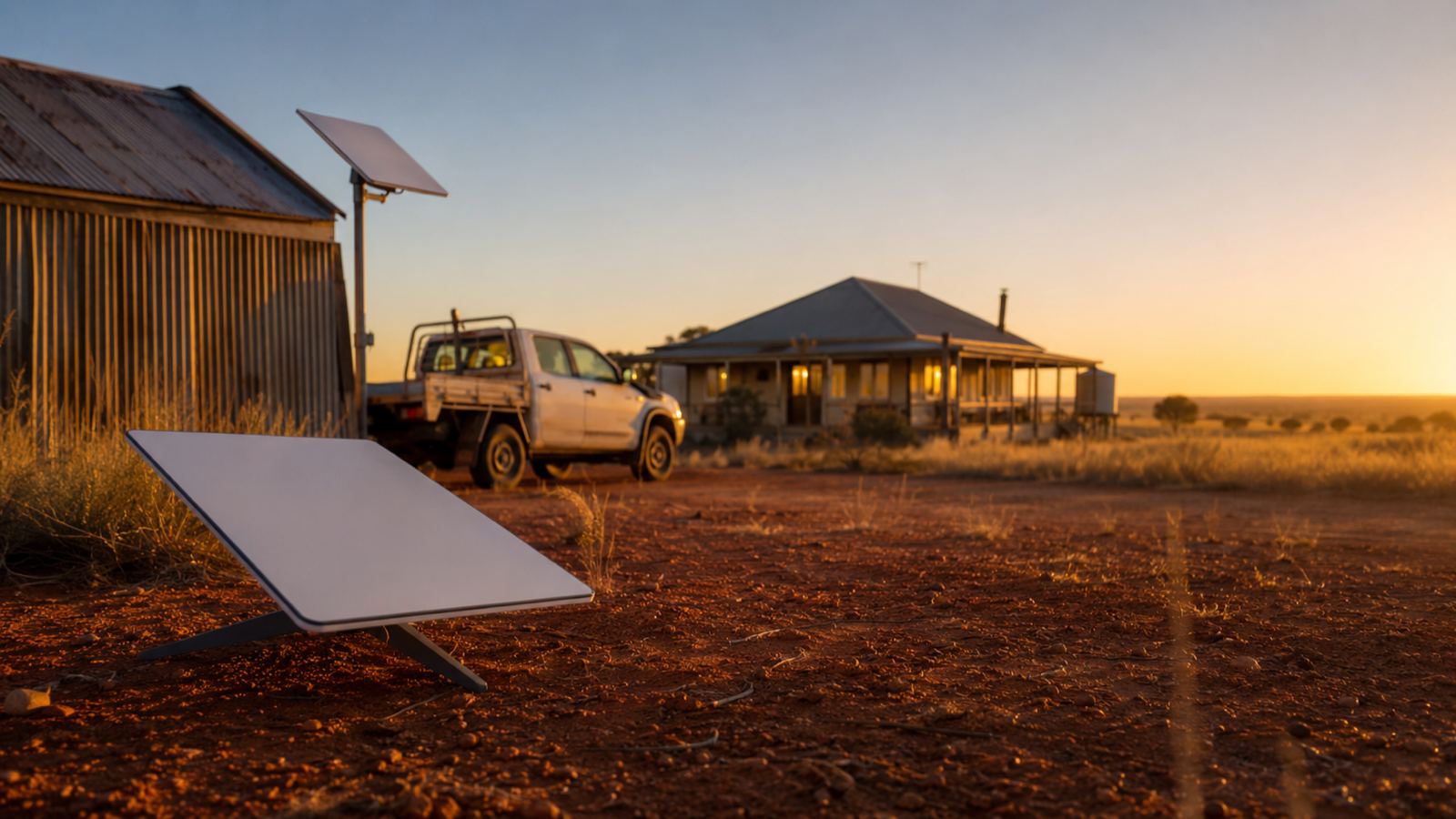
Residential plans start at $75 a month, Roam starts at $85, and the hardware is a separate cost that changes depending on where you live. Those are the numbers as at 4 September 2026, read off Starlink’s own Australian site rather than copied from another article.
That last part matters more than it should. Most of the pages ranking for this search are quoting prices that stopped being true in June.
Every Starlink plan and price in Australia right now
| Plan | Monthly | What you get |
|---|---|---|
| Residential 100 Mbps | $75 | Unlimited data, downloads capped at 100 Mbps. Select areas only. |
| Residential 200 Mbps | $110 | Unlimited data, capped at 200 Mbps. Select areas only. |
| Residential Max | $150 | Uncapped speeds, top Residential network priority, Home Pro install included, and you can add an optional Starlink Mini on a discounted Roam plan. |
| Roam 100GB | $85 | 100GB at full speed, then unlimited data at reduced speed. Your home country only. |
| Roam Unlimited | $210 | Unlimited full-speed data, and it works in over 160 countries. |
Checked against Starlink’s Australian service plans page on 4 September 2026. All figures in Australian dollars.
Two caveats worth having up front. The two cheaper Residential tiers are only sold in areas Starlink has decided have spare capacity, so the $75 plan may simply not appear when you enter your address. And promotions come and go by postcode, so the price you see may be lower than the one above.
Why none of these prices will stay put
Satellite internet in Australia has gone from one provider to a genuine fight, and the pricing is moving accordingly. Three things have already happened this year:
- In January 2026, Starlink doubled the Roam entry plan from 50GB to 100GB at no extra cost, and stopped cutting people off at the cap.
- In June 2026, Starlink repriced the whole Australian range upward, which is what broke every comparison site still quoting the old numbers.
- Starlink is now discounting hardware hard in places, from $289 in some areas down to nothing at all in others.
Two more are already dated in the diary:
- Telstra lifts its Starlink-powered plan from $125 to $150 a month on 29 September 2026, and at the same time removes the 50 Mbps cap in favour of an estimated 170 to 320 Mbps. Price up, product up.
- nbn is replacing Sky Muster with nbn LEO, powered by Amazon Leo, offering uncapped data at wholesale speeds of up to 50/10 and 100/20 Mbps. nbn says eligible customers can expect to begin transitioning from around mid-2027.
That last one is the interesting one. Sky Muster was never really a competitor to Starlink on quality, so Starlink has had the remote market largely to itself. A government-backed low-orbit service covering the whole nbn satellite footprint changes that, and providers tend to move on price well before a competitor actually launches.
What this means for you is simple and slightly annoying: do not trust any published price table, including this one, without checking the date on it. Put your address into the provider’s own site on the day you order. A number that was right in September can be wrong by Christmas, and this market is moving faster than the pages writing about it.
What is the cheapest Starlink plan in Australia?
On paper, Residential 100 Mbps at $75. In practice, the cheapest plan you can actually buy is often Roam 100GB at $85, because the cheap Residential tiers are not offered everywhere.
The catch with Roam 100GB is worth understanding before you pick it on price. You get 100GB at normal speed. After that Starlink does not cut you off, it drops you to unlimited low-speed data, which is fine for messages and maps and not fine for anything else. If you stream in the evenings, 100GB disappears faster than you expect.
There is no $50 plan in Australia. That figure comes from American coverage of the US Roam pricing and it gets repeated here constantly. The cheapest Starlink plan sold in Australian dollars is $75 for Residential where it is available, or $85 for Roam.
The hardware is a separate cost, and it moves
This is where most articles go wrong, including ours until today.
Starlink’s Roam page currently says hardware starts from $289 in selected areas. The Residential page says some addresses get no upfront hardware cost at all. Telstra sells the Standard kit outright for $549.
Three different numbers, all correct, all depending on where you live and what is running that week. Anyone quoting you a single confident hardware price for the whole of Australia is guessing, and that includes the pages telling you it costs $499.
The only honest answer is to put your address into Starlink’s site and read what it says for you. It takes about thirty seconds and it is the only figure that applies to your order.
Starlink direct, or Telstra?
Telstra resells Starlink as Telstra Satellite Internet. It is a genuinely different product with different tradeoffs, not just a markup.
| Telstra Satellite Internet | Starlink direct | |
|---|---|---|
| Monthly | $125, rising to $150 from 29 September 2026 | From $75 |
| Speed | Capped at 50 Mbps until 29 September 2026, then an estimated 170 to 320 Mbps | Uncapped on Residential Max, capped on the cheaper tiers |
| Hardware | $549 outright for the Standard kit | From $289, sometimes nothing, depends on address |
| Extras | Telstra Smart Modem, home phone over Wi-Fi, Australian support, Telstra Plus points | None of that |
If you already run everything through Telstra and you want one bill and a local support number, the premium buys you something real. If you just want the internet, going direct is cheaper, and after 29 September the gap gets wider rather than narrower.
One thing to know either way: a kit bought through a retailer or reseller is a reseller purchase, and Starlink treats those differently from an order placed on its own site.
Is Starlink cheaper than NBN or Sky Muster?
Against a city NBN plan, usually not, and it is not trying to be. If you can get fixed-line NBN at your address, get it. Starlink is not competing for that customer.
The comparison that actually matters is against Sky Muster, the NBN satellite service, and there the difference is not really price. It is latency. Sky Muster uses geostationary satellites sitting about 36,000 km up, so every request makes a very long round trip and video calls feel like a delayed phone line. Starlink runs in low Earth orbit, a few hundred kilometres up, and the difference is immediately obvious on a video call or in a game.
If your only options are Sky Muster, congested fixed wireless or a mobile hotspot balanced on a windowsill, Starlink is a different category of connection rather than a slightly better one.
Which plan suits which person
A rural or regional household. Residential. Start with the cheapest tier your address is offered. You can move up later without buying anything new, and most households never hit the ceiling on the 100 Mbps plan.
A caravanner or full-time traveller. Roam. Roam 100GB if you are away a few weeks a year and mostly want maps, messages and the occasional film. Roam Unlimited if you live in the van, work from it, or stream every night. The $125 a month between them is real money, so be honest about which one you are.
A remote worker on contract. Roam Unlimited, and expense it. Standby mode lets you pause between jobs. If you work from home permanently rather than on the road, Residential is the cheaper plan and the right one.
Someone going on one trip. Do not buy anything. A month of Roam Unlimited plus hardware is a lot of money for a fortnight in the Kimberley, and you will spend part of that fortnight learning the app. We hire kits out of Perth for exactly this, and we have worked the break-even out properly if you want to check the maths rather than take our word for it.
Pausing, moving house, and stopping
Roam bills in one-month blocks and has a Standby mode, which drops you to a small monthly fee, keeps emergency messaging alive and lets you switch back on from a dead zone. If you travel twice a year, you pay for the months you use rather than twelve of them, which changes the buying maths considerably.
Residential is sold as home internet for a fixed address, so it is the wrong plan if you are constantly moving. If you are simply moving house, that is a service address change rather than a new plan.
There is a 30-day trial with a full refund if the service does not work at your place. Given how much depends on your particular sky view, that trial is the real answer to “will it work here”.
What the speeds actually mean
Netflix in 4K wants about 25 Mbps. A Zoom call wants about 4 Mbps. A $75 Residential plan capped at 100 Mbps runs several of both at once without complaint.
Gaming is the one where the plan tier matters less than you would think and the sky view matters more. Latency on Starlink is normally fine for anything except competitive shooters. A branch clipping the edge of the dish’s view will ruin a game far more reliably than choosing the cheaper plan.
Our own hire kits come back reading between 100 and 200 Mbps down across regional WA, which lines up with what the plans promise. The measured detail is here, with locations and dates.
Prices you will still see quoted, that are wrong
Starlink repriced across Australia in June 2026 and most published pages were never updated. If you see any of these, the page is out of date:
- $69 a month for Residential. Old price, now $75.
- $99 a month for Residential 200 Mbps. Now $110.
- $139 a month for Residential or Residential Max. Now $150 for Max, and $139 is not any current plan.
- $195 a month for Roam Unlimited. Now $210.
- Roam 50GB at $80. The data doubled to 100GB in January 2026, and the price moved to $85 in the June reprice.
- Residential Lite. Not on the current Australian plan menu. Starlink’s own referral help page still lists it among eligible plans, so the name has not been fully retired internally, but it is not something you can select at checkout here today.
- $499 for the hardware, quoted as a national figure. Starlink’s own site says from $289 in selected areas.
This is not a dig at the comparison sites. It is what happens to every price page that nobody goes back to, and it is why the date at the top of this one matters. If you are reading this well after September 2026 and we have not restamped it, treat our numbers with the same suspicion.
Frequently asked questions
Is Starlink or Telstra better? Cheaper and faster direct, especially after Telstra’s September increase. Better through Telstra if you want one bill, a modem, a home phone line over Wi-Fi and a local support number.
What is the cheapest Starlink per month? $75 for Residential 100 Mbps where it is available, otherwise $85 for Roam 100GB. There is no $50 plan in Australia.
Is Starlink cheaper than NBN? Not cheaper than a metro fixed-line plan. Against Sky Muster the case for Starlink is latency rather than price, and the gap there is large.
Is Starlink fast enough for Netflix? Yes, including 4K, on every current plan while you are within your full-speed data.
Can I install it myself? Yes. Most people are online in under five minutes with the kickstand. Roof mounting is the part worth paying someone for, and Residential Max includes a professional install.
Can I take it when I move house? Residential is sold for a fixed address, and moving house is a service address change. Roam is built to move with you.
Can I pause it? Roam, yes, via Standby mode. Residential is a continuous monthly service.
Is Starlink worth it in Australia? If your alternative is Sky Muster, congested fixed wireless or no service, comfortably. If you can get fixed-line NBN, no.
Before you order
Put your address into Starlink’s site and read the actual price and hardware cost for your location, because that is the only figure that applies to you. If the trip is short, hire one instead and find out whether satellite internet suits how you travel before spending anything.