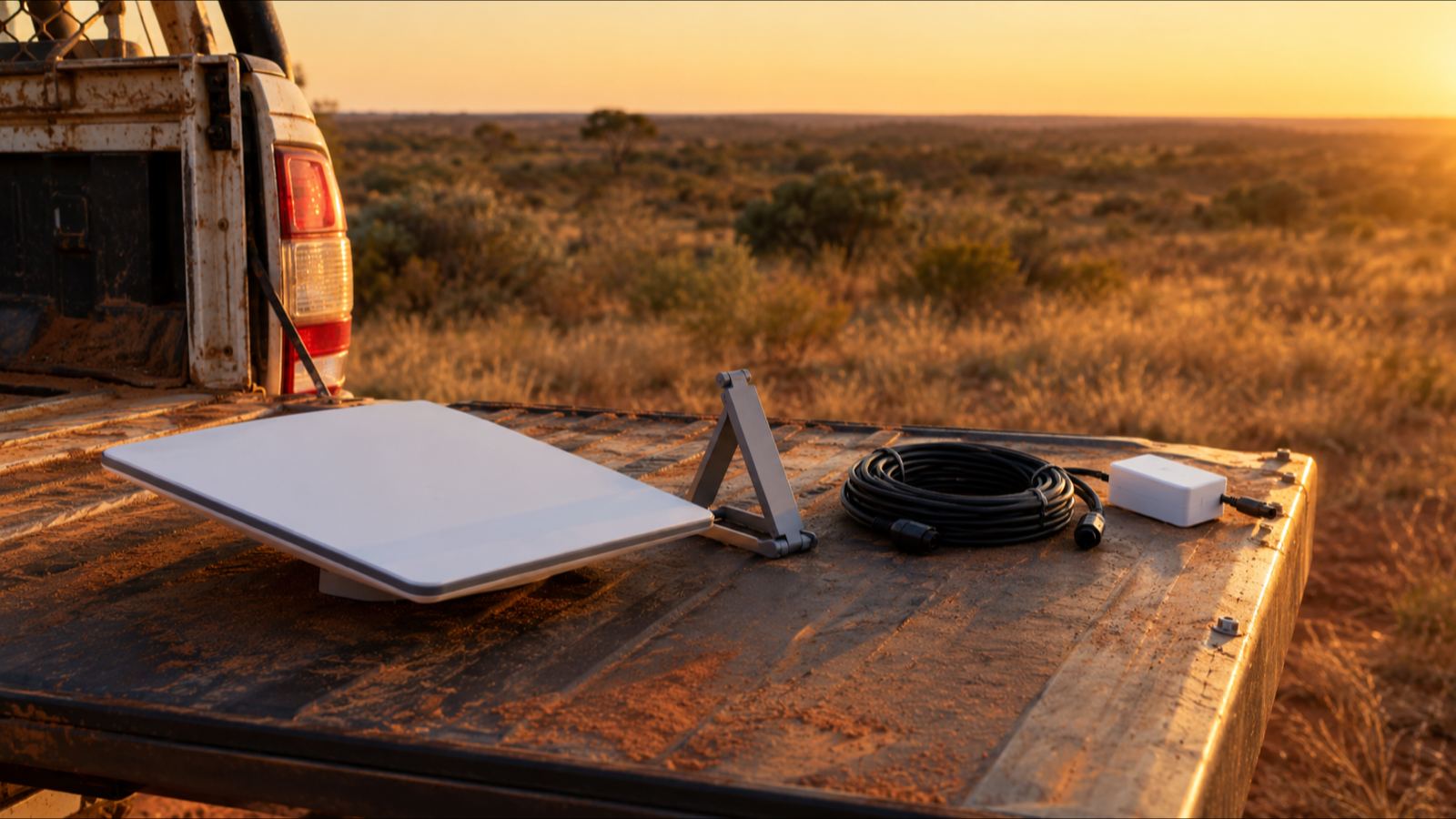
A Starlink Mini is $287 to $399 depending on where you buy it. Plans start at $75 a month. So a realistic first year, buying a Mini outright on the cheapest Residential plan, is about $1,188.
That is the simple version. Two things make it messier, and one of them can add over a thousand dollars.
Why every price you find is different
Search “starlink cost australia” and you will get half a dozen numbers. There is a reason, and it is not that everyone is careless.
Google ranks Starlink’s American pricing page on Australian searches. As at 7 September 2026, both starlink.com/service-plans and starlink.com/au/service-plans appear on the same Australian results page. One shows $55, $85 and $130 a month. The other shows $75, $110 and $150. Same company, same layout, no currency label in the snippet.
The first set is US dollars. The second is ours. That single overlap explains most of the confusion online, including the steady stream of people searching for a “$50 Starlink plan” that has never existed here.
The rest is staleness. Starlink repriced across Australia in June 2026 and most published pages were never updated, so figures like $69, $99, $139 and $195 are still circulating as though they were current. We keep the live plan table on our Starlink plans page.
Hardware: what a kit actually costs here
Checked 7 September 2026:
| Where | Starlink Mini | Standard 4 X |
|---|---|---|
| Bunnings | $287, in-store only | $502 |
| Officeworks | $287, free delivery | $497 |
| Harvey Norman | $288, limit one per customer | not listed |
| JB Hi-Fi | $289 | $499 |
| BCF | $399, or $289 with free Club membership | not listed |
| Starlink direct | from $289 in selected areas | varies by address |
| Telstra | not sold | $549 outright |
Starlink’s Residential page also says some addresses get no upfront hardware cost at all, which is a promotion rather than a standing offer.
Two things worth noticing. The Mini has settled at $287 to $289 across six independent sellers, so anyone quoting $499 or $599 for a Mini is working from old information, including Google’s own AI summary as at 8 September 2026. We list every seller and what each is good for on our where to buy Starlink page. And buying at a retailer is a reseller purchase, which Starlink treats differently from an order placed on its own site.
The fee nobody mentions
This is the part that makes a mess of budgets, and almost no comparison page covers it properly.
Starlink charges a location-based demand surcharge in high-demand areas. Harvey Norman’s own product page states it plainly:
Some plans may include a location-based demand surcharge (up to $1295 as at 14/08/2025), shown before activation.
Up to $1,295. One off, applied at activation, based on your service address. Google’s AI summary currently puts this at “up to $145”, which is not the figure the retailer selling the starlink hardware is publishing.
The logic behind it is congestion. Starlink sells capacity per cell, and where a cell is already busy the network cannot add another household without everyone’s download speeds suffering. The surcharge is how it rations that, and it is why two neighbours can be quoted differently.
Two caveats, because this matters and I would rather be useful than dramatic. That $1,295 is Harvey Norman’s stated ceiling as at August 2025, so it is over a year old and the number may have moved. And it is a ceiling, not a typical charge: most addresses pay nothing. The point is that it exists, it is address-specific, and it is shown to you before you activate.
There is one more. Activating an Australian kit outside Australia can attract a $300 Outside Region Fee, charged in the local currency of wherever you switch it on.
So the only way to know your real cost is to enter your address. Not a postcode into a comparison site, your actual address into Starlink’s checkout, which shows the hardware price, any promotion and any surcharge before you pay anything. Any article that gives you a single confident national figure, this one included, is giving you an average.
What a first year actually looks like
Buying a Mini at the $287 floor and running it for twelve months:
| Plan | Monthly | Hardware | First year total |
|---|---|---|---|
| Residential 100 Mbps | $75 | $288 | $1,188 |
| Residential 200 Mbps | $110 | $288 | $1,608 |
| Residential Max | $150 | $288 | $2,088 |
| Roam 100GB | $85 | $288 | $1,308 |
| Roam Unlimited | $210 | $288 | $2,808 |
Add any demand surcharge on top. Subtract any promotion running at your address.
What that buys is worth stating, because the monthly figure looks steep next to a city internet plan. Every Residential tier includes unlimited data with no excess charges, and the ACCC measured Starlink delivering 230.4 Mbps across all hours on Residential Max, so this is high-speed internet rather than a compromise you tolerate for being remote. There is no lock-in contract on any of it.
The number that surprises people is the bottom row. Roam Unlimited is the plan most full-time travellers assume they need, and over a year it costs more than double the entry Residential plan. If you are away six weeks a year rather than fifty-two, Standby mode between trips is the difference between paying for two months and paying for twelve.
Against Telstra
Telstra resells Starlink as Telstra Satellite Internet at $125 a month, rising to $150 from 29 September 2026, plus $549 for the Standard kit.
First year through Telstra, at the new rate: roughly $2,349. First year direct on Residential 100: $1,188.
The premium buys a Telstra Smart Modem, a home phone line over Wi-Fi, Australian support and Telstra Plus points. Whether that is worth around $1,100 in year one is your call, but it should be a decision rather than an accident.
Against the alternatives
Against fixed-line NBN in a city, Starlink is more expensive and slower. If you can get fibre, get fibre. This is not a close call and nobody at Starlink pretends otherwise.
Against Sky Muster, the comparison is not really about money. Sky Muster’s geostationary satellites sit about 36,000 km up, which is why the ACCC measured its average latency at 664.9 ms against Starlink’s 29.8 ms. You are buying a different category of connection, not a cheaper one.
Against a prepaid mobile hotspot, if you are staying near towns, the hotspot wins on cost every time. Satellite earns its place once you are genuinely past the towers.
When buying is the wrong answer
Twelve months of Residential 100 plus a Mini is $1,188. A fortnight’s hire from us is $358 plus a refundable bond.
If this is one trip, buying is a lot of money to answer a question you can answer for a fortnight’s rent. Not modesty, just the actual maths, and we have worked the break-even out properly rather than asking you to take our word for it. Roughly speaking, past about six weeks of use, buying wins.
Our Starlink hire out of Perth runs one plan, unlimited, at $179 a week for 7 to 13 days, $22 a day from 14 days and $19 a day from 25 days, with a $300 refundable bond and a 10% deposit. No setup fee, no delivery charge, no hidden costs.
Common questions
How much is Starlink per month in Australia? $75 for Residential 100 Mbps, $110 for Residential 200, $150 for Residential Max, $85 for Roam 100GB and $210 for Roam Unlimited.
What is the cheapest way to get Starlink? Residential 100 Mbps where it is offered, on hardware bought at the $288 to $289 mark, and watch for the free-hardware promotions that appear at some addresses.
Is there a $50 Starlink plan in Australia? No. That is the American price ranking on Australian searches. The cheapest here is $75.
What is the Starlink startup cost? Hardware plus your first month, so about $363 on the cheapest combination, unless a demand surcharge applies at your address.
Are there ongoing fees beyond the plan? Not routinely. Standby mode carries a small monthly fee if you pause a Roam plan, and there is no lock-in contract on any plan.
Is Starlink cheaper than NBN? Not against fixed-line NBN. Against Sky Muster the case for Starlink is latency rather than price: the ACCC measured 29.8 ms against Sky Muster’s 664.9 ms.
Can I get a refund if it does not work? There is a 30-day trial with a full refund, which given how much depends on your particular sky view is the real answer to “will it work at my place”.
Before you order
Put your address into Starlink’s site and read the hardware price, the promotion and any demand surcharge for your location. That is the only figure that applies to you, and it takes about thirty seconds. If the trip is short, hire one instead.